Le séminaire international de naginata de la Fédération internationale de naginata (FIN) 2026 a été organisé par la Fédération australienne de naginata du 26 au 28 juin à Melbourne, en Australie. Le séminaire était animé par :
Chinobu Imaura, Kyoshi
Toko Takahashi, Kyoshi
Ayumi Nakadan, Kyoshi
Alex Bennett, Godan
Le Canada était représenté par Sam Zhou, Henintsoa Rakotomalala et Jeffree Chen.
Jeffree, Sam et Henintsoa, avec Peter, du dojo de Sydney où Dan Bouchard-sensei s'entraînait autrefois
Au programme de ces trois jours : les techniques de base, le shikake-oji et les kata, avec de nombreux commentaires précieux de la part de sensei d'Australie et du Japon. Il faisait plutôt froid (c'était l'hiver en Australie !), mais la chaleur de la compagnie et les nombreuses pratiques ont permis à tout le monde de se réchauffer. Ce fut aussi l'occasion de retrouver de vieilles connaissances et de tisser de nouveaux liens avec des naginata-ka de partout en Asie et en Océanie : d'Australie, de Hong Kong, de Malaisie et de Nouvelle-Zélande. Le séminaire s'est conclu par un tournoi informel d'engi et de shiai.
Dans l'ensemble, ce fut une expérience très amusante et très enrichissante, et notre délégation a beaucoup appris !
Un moment de calme face à l'horizon de Melbourne avant de rentrer à la maison
Le Séminaire national de la FCN 2026 s'est déroulé les 27 et 28 juin à l'Association récréative Milton-Parc, à Montréal. Des pratiquantes et pratiquants venus de partout au pays se sont réunis pour deux jours de keiko, couvrant les fondamentaux, le shikake-oji, les kata et le shiai-geiko, avec un passage de grades le dimanche.
Voici ce que quelques participants en ont pensé :
«Le séminaire était bien organisé et les instructeurs donnaient des explications claires. J'ai apprécié l'occasion de pratiquer avec des participants de différents niveaux et d'échanger avec la communauté.»
— Kylian Lionnet, D.N.C.U.M, 2026
«C'était pas mal fun ! J'aimais bien que les niveaux étaient mélangés de temps en temps, mais j'imagine que c'est surtout fun pour les débutants XD.»
— Amiel Gélinas, D.N.C.U.M, 2026
Merci à toutes les personnes qui ont participé, enseigné ou aidé à organiser ce séminaire. Nous espérons que chacune et chacun est reparti motivé et outillé de nouvelles connaissances et compétences à partager avec son dojo d'origine !
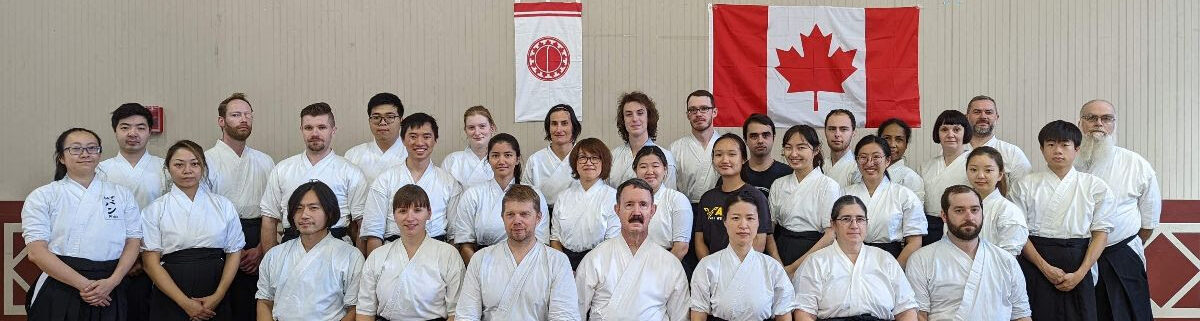
Photo de groupe du Séminaire national de la FCN 2026
Le Tournoi de naginata de Toronto 2026 s'est tenu le 23 mai 2026, à Toronto, au Canada. Le tournoi a accueilli un nombre record de participantes et participants cette année, dont un important contingent venu des États-Unis. Merci beaucoup à Jordan Macklem pour l'organisation du tournoi !
Après 85 combats au total, voici les résultats finaux :
Individual Shiai 1re – Jordan Macklem (JCCC) 2e – Marija Landekic (Rosemont) 3e – Dan Bouchard (Burnaby) 3e – Andrew Boyd (River Valley)
Félicitations à toutes et à tous, et merci à toutes les personnes venues participer, faire du bénévolat et s'encourager mutuellement !
Toutes les participantes, tous les participants et les médaillés du tournoi de cette année !
Sam Zhou (3-dan, CNF Media and Communications Officer) had the chance to practice at several different dojos across Japan. Here are the highlights:
I had the opportunity to spend several months in Japan and to visit 4 different dojos from Hokkaido to Kyushu, and it was interesting to see how different kinds of practices were done.
Sapporo
I went to a couple of dojos in Sapporo (there are essentially only 2 dojos in Hokkaido, and both are in Sapporo). The Chuo-ku Kitagas Arena dojo is a community dojo mostly attended by elderly women. Practices there focus primarily on datotsu (basics) and shikake-oji, with some kata occasionally. I also went to the high school practices at Hokkaido Sapporo Intercultural and Technological High School with UTNC alum Andi Li. High school practices are a different pace: around 3/4 of it is bogu practice. The club is mainly run by older students and university students who are alumni of the high school. They were preparing for Interhigh, so they were doing many repetitions of drills. Practices were 4 hours on the weekends, with water breaks every half hour for 10 minutes or so, then back at it again with more datotsu, short strikes, nuki-waza, and enjin-geiko (circle keiko). They also made up fun exercises to practice the timing of strikes.
Kobe
Oji Sports Center Dojo
I also travelled to Kobe to practice at the Oji Sports Center dojo with Lutan Liu (UTNC alum). This was again a community dojo, but with a different range of participants. Here, people are of all ages, from middle school girls and their dads to older adults in their 40s-50s and up. There’s something for everyone.
They were actually doing Jikishinkage-ryu practice before naginata, so I tried it out and learned the first 3 katas. It was a very unique and interesting experience, and I highly recommend trying it, even though it is pretty difficult to pick up (essentially everything about it is different from atarashii naginata!).
I (on the right side here) managed to get a sune strike in hehehe 😛
Bogu practice was led by Lutan, and I got to keiko with students from a nearby university who want to start a new naginata club.
Kumamoto
The following week, I went to Kumamoto. A magnitude 6.8 earthquake struck there the day before my flight, but since my flight wasn’t cancelled, I went anyway. Kumamoto itself was still in functional shape overall; it was hit much harder further south in the city of Uki, which was the epicentre. Life went on after the earthquake, though there were small aftershocks rolling through in the evenings.
I went to visit Reigando Cave, where the famous Miyamoto Musashi spent the last years of his life writing The Book of Five Rings, among other works. I thought I’d pay my respects and do a little hike through the mountain highways, among kumquat trees and bamboo forests.
My main goal in Kumamoto, though, was to attend a naginata practice. The Interhigh competition was coming up, and to prepare, Kumamoto Daiichi High School held a special training practice on the weekend. A friend I met through the INF, who worked in the JET (Japan Exchange and Teaching) Program, practices regularly at that high school, so I got to attend this practice.
Kumamoto used to be a powerhouse for high school naginata, with Kumamoto Nishi High School winning 5 consecutive team championships back in 2001. They were supposed to come to this special training too, but with the earthquake, they weren’t able to make it. I got to keiko a bit with the students. They were very fast, and you could tell that they are a very strong team.
I hope by sharing these experiences and stories that naginata practitioners outside of Japan can get a better idea of what practices at dojos are like around different parts of Japan. If you are travelling to Japan and want to practice naginata there (and are a member of the CNF), make sure to contact the CNF (ideally a couple months beforehand) and we could potentially help connect you!
This spring, Kaori Kubo, along with Mary Phan and Marija Landekic travelled to Japan to train in Okayama and Himeji. Congratulations to Kaori-sensei for taking the Renshi exam and on achieving the title of Renshi! Here are some highlights from the trip:
Okayama gasshuku on May 3rd. High school and adult players from 6 prefectures took part in an 8-hour practice, with around 80 participants that day. Photo credit: @mimasaka.naginataHimeji Prefectural Budokan practice on May 8th. My high school teacher runs the dojo there. The Renshi exam was held in the budokan this year. Photo credit: @himeji_naginataOur visit to Musashi Shrine in Mimasaka city, just a 30-minute drive from my home, if anyone is interested in visiting one day!
“We had 30 Renshi candidates this year, and we took the exam by age. 9 of us had successful results.”